Free newspapers!

Eight free papers in Philly

I love checking out the free newspapers in a new city.

Philadelphia was a special treat because, while I can usually find only one, maybe two, free tabloids in a city, I found eight.

I traveled to the city of brotherly love to attend the Justice Conference as part of a class I am taking at Bryan College. The Justice Conference is a gathering of Evangelical Christians talking about issues surrounding social justice.

The free-newspaper deluge began at 7:30 a.m. as I opened the hotel room door to discover complimentary copies of USA Today. Perhaps I shouldn’t term this as a free paper because I did not find it on the street, but it did provide a lot of information and a sense of sophistication as I carried it to the lobby.

Throughout the day, I would go to the rusted newspaper stands marked with tags and stickers and peel back the doors to collect another paper.

Because I was attending sessions all day, I have not had the chance to look at the papers closely. I glanced at headlines and looked at newspaper design.

The papers are diverse. Some have a local-newspaper look Other papers are put together more like magazines. I’m sure the writing will differ as widely.

These alternative papers will provide a street-view of the city, providing a window into the concerns of each sector of the community. And there are diverse communities. Among the papers, I picked up a LGBT paper, a campus newspaper, a Spanish paper and an arts paper.

However, I’m not quite done. When I was walking to the Liberty Bell with the rest of the Bryan students, I saw a Chinese paper, and I know there is Street-Sense-type paper also sold in Philly.


So there’s a zero tolerance policy towards language?

Last Friday, I compiled the links for Triangle’s email blast. Every week, I have been trying to compile a list of stories that the writers at Bryan Triangle wrote during the last week because it gives the stories more publicity.

Besides just making the email a summary of what is on the Bryan Triangle website, I also want to include links to outside stories, stories that may challenge readers, stories that talk about the big news of the day or stories that I find entertaining. I was trying following the model that Mike Allen uses when he creates the Politico Playbook, one of the email blasts for The Politico.

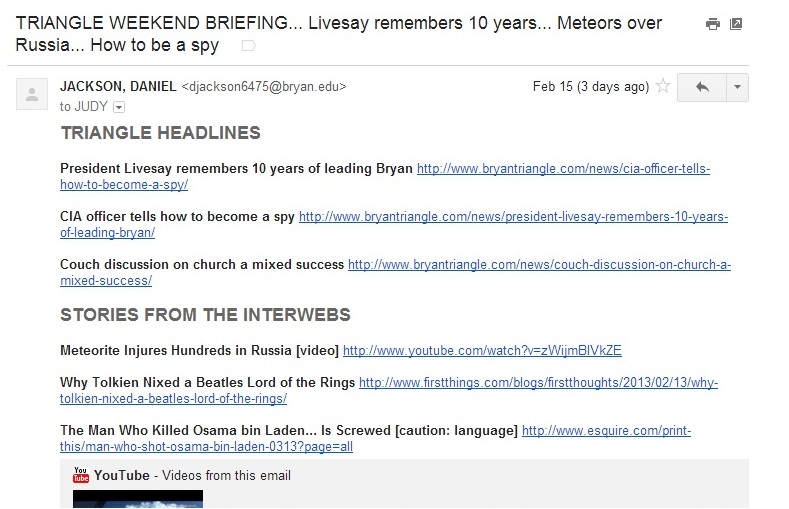
So far the emails have been going well. The editor-in-chief of Triangle has told me he liked how the emails looked. Friday afternoon, I sent out this email:
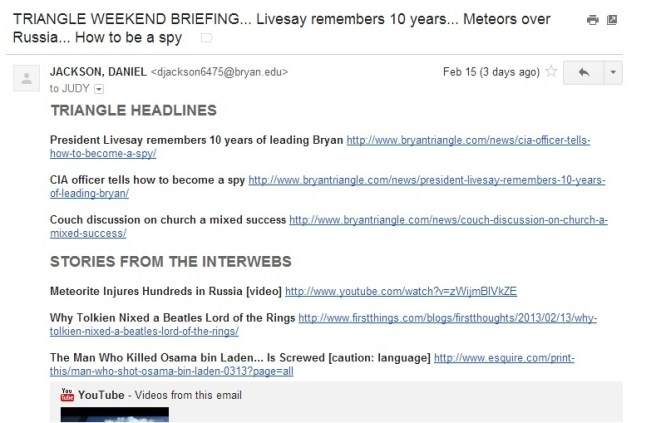
Triangle Weekend Briefing Original

Normally, the email is sent out to the students, faculty and staff a few minutes after I send the email to the office which coordinates the mass emails on campus.

This time, the mass email did not arrive in my inbox on Friday. I didn’t think much of it. I sent it out at the end of the day and I thought the office might not have had time to send it out before closing.

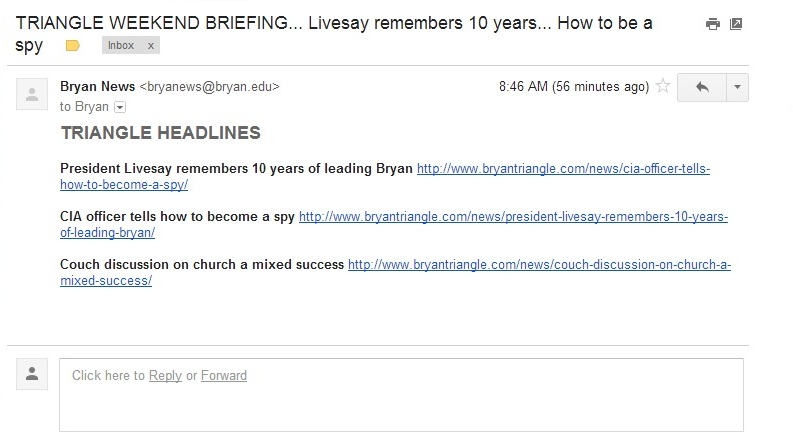
Next Monday, however, the email came like this:
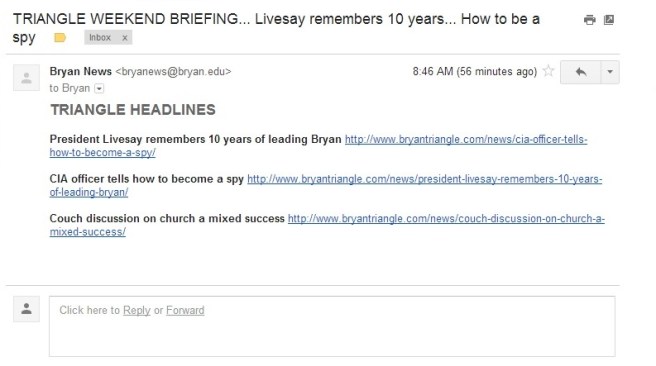
Censored Triangle Weekend BriefingHalf of the links were deleted. The headline talking about the meteor over Russia which sent hundreds to the hospital, deleted.

I don’t know exactly why half my email was gone. My first guess is that they found the story about the Navy Seal who shot Usama Bin Ladin inappropriate because of language.

There are 18 uses of the F-bomb, 20 uses of Sh*t, in the story. In every instance except one, the author is quoting the Navy Seal.

I decided to include the story because I thought the story was more important than the language. The story was a profile about a man that we would never know any other way, a man whose military action changed the world.

It was an excellent story. Phil Bronstein, former editor of the San Francisco Chronicle, worked with the Center for Investigative Reporting to create this story. The story had both a compelling narrative and sharp, sharp research.

By leaving the course language in his story, Bronstein created a picture of gritty realism.

I admit, not many publications print stories with language. Most newspapers shy away from works like ‘sh*t” and ‘f*ck’ in order to create a professional tone in the paper. Some readers don’t like reading stories with language.

That is why I warned readers of the language in the story. I wanted to let the readers choose whether or not to read the story which I found notable.

I don’t use language myself when writing stories, but I also recognize that those words, like any other words, can describe situations with the most precision.  If a source says something important using language that may offend polite society, I may  quote them anyways because it accurately describes the situation.

But why did the college delete every single link to outside publications? The Wall Street Journal video about the meteor was straight news reporting. The First Things blog post about JRR Tolkien and the Beatles was harmless.

I know the college is the ultimate publisher of everything Bryan Triangle, that we have almost no legal right to operate as conventional journalists. I get that.

But compiling that email and choosing all its links was my job. Getting censored still stings.

The community in the state capitol

Photo by Daniel Jackson
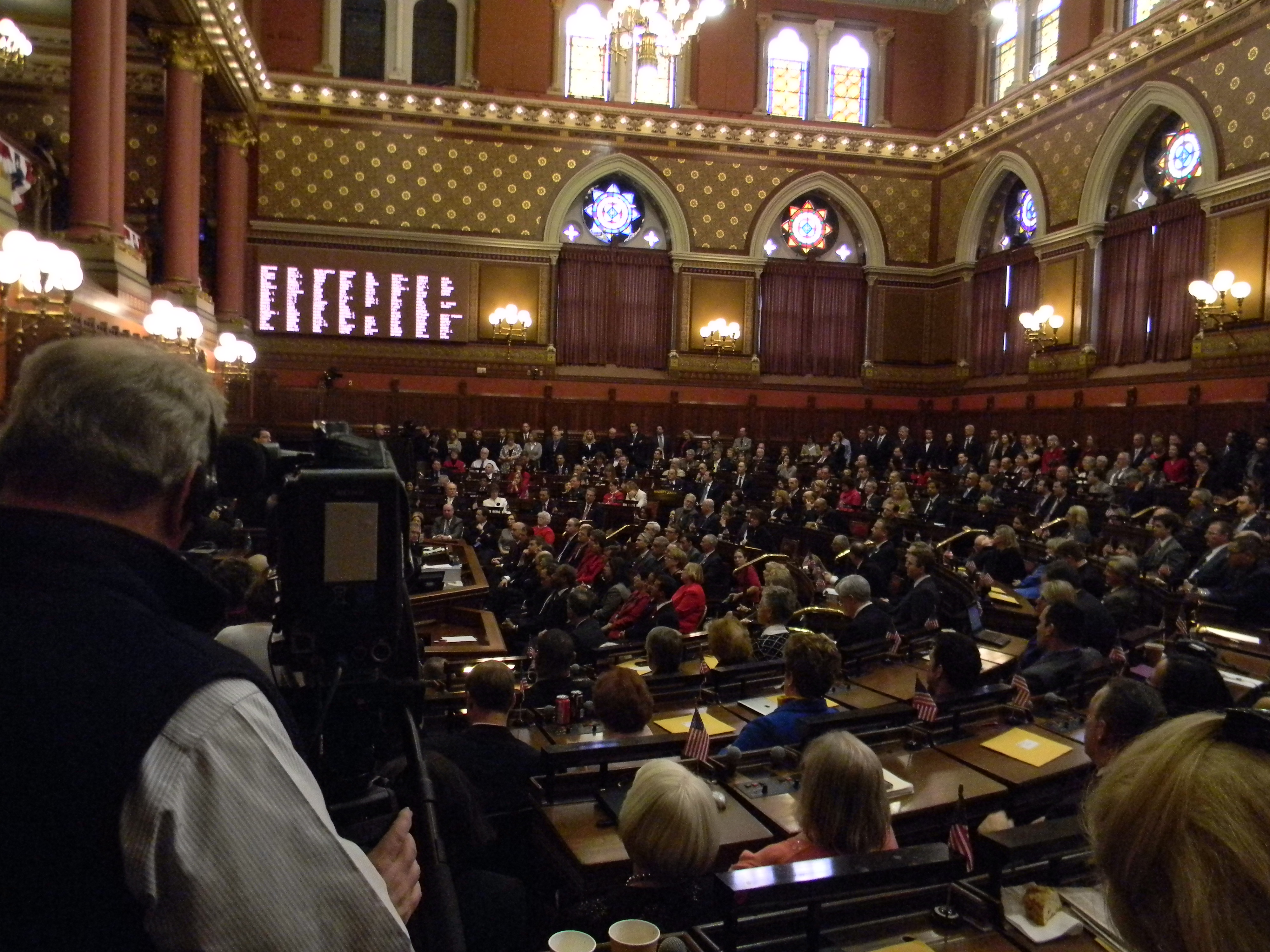
Last week was a whirlwind for me. A last minute story assignment led me to shadowing a state representative and standing in the Connecticut house chamber witnessing the swearing in of the house and Governor Dannel Malloy’s state of the state address.

The mood in the capitol was different than what I expected. While the legislators were recognizing the work ahead–the tragedy in Sandy Hook cast a shadow on the day–the legislators joked with each other, gave each other advice and called themselves close friends and family.

On the first day, representatives were learning the proper procedure for conducting government. When former House Speaker Chris Donovan listened to the roll being called, one representative stumbled when he recognized his name. Donovan just told the representative “present” or “here” are acceptable procedure when responding to a roll call.

When Donovan gave his parting speech, he said he was proud of what the house accomplished, and he told the new representatives they would find some of their closest friends among the politicians gathered there.

House Minority Leader Larry Cafero told the representatives to take care of their health.

When Cafero and House Majority Leader Joe Aresimowicz nominated J. Brendan Sharkey as Speaker of the House, both talked about how the man was a policy wonk and a prankster.

Sharkey was sworn in and he told the legislators that when a group came to escort him to the house floor, he hid in his bathroom in the capitol.

“It took a while, but we worked it all out,” he said.

And of course, the legislators brought their wives, mothers and children to witness the first day.

During the Finance, Revenue and Bonding Committee, the representative from Manchester, Jason Rojas, held one daughter on his lap while his other daughter drank a soda by his chair.

Little things, yes, but it’s a side of the legislature we don’t see through political news reports.

Photo by Daniel Jackson

The badge vs the camera


DSCN9611

I told him his photograph would not appear in the newspaper.

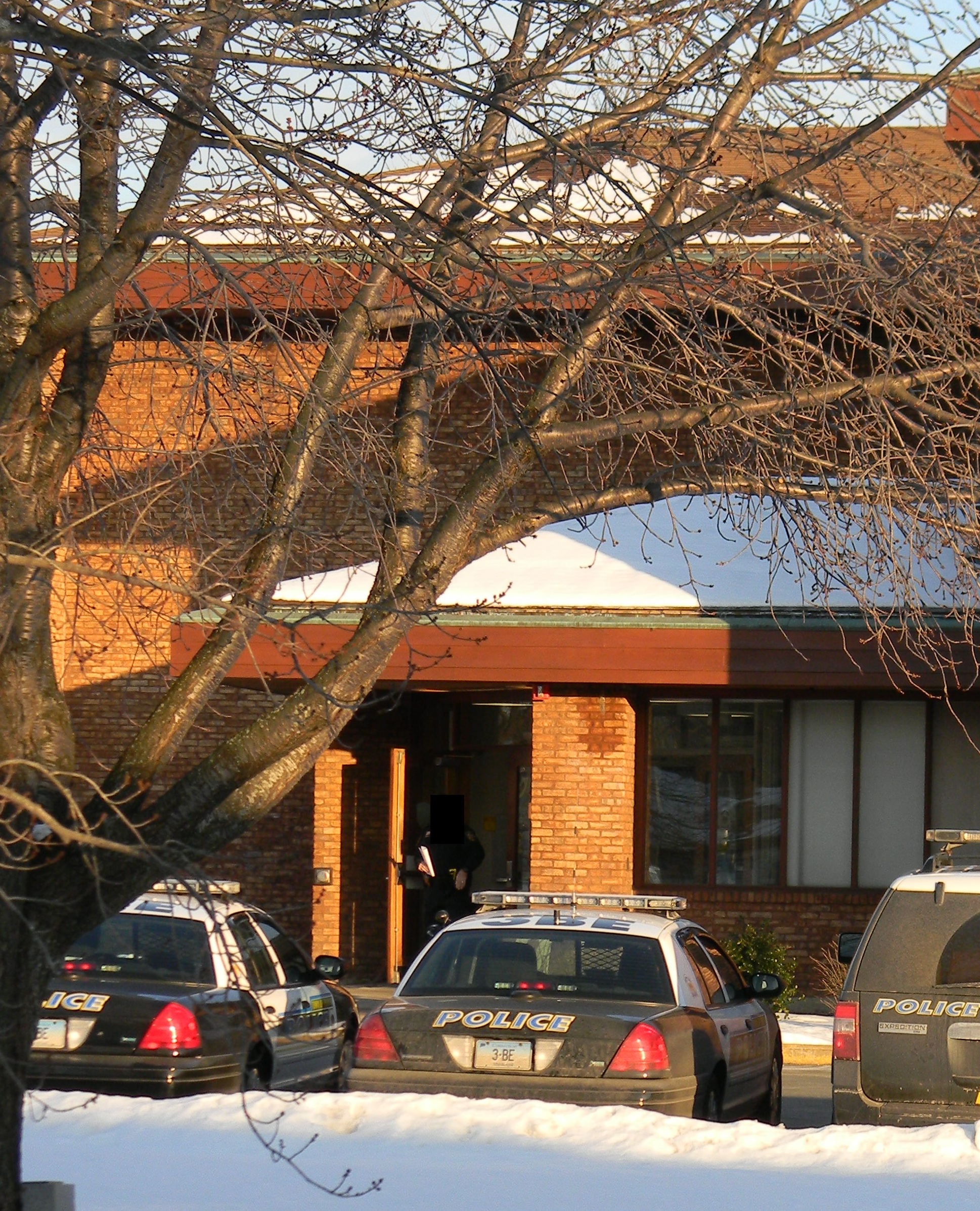
That is why I blacked out the police officer’s face in the above photo, because I gave him my word. I was illustrating a story I wrote about my police department and needed a photo. So instead of just snapping a photo of the front of the building and being done with it, I looked to find an interesting angle. Then he came out.

He was a person. He was moving. He was thus interesting.

I continued shooting and then ran around to the front to get a better angle of him driving away in the police cruiser. As I captured that shot, he saw me.

The cruiser stopped. A pause. He asked me what I was doing.

I was from the paper, I told him.

Did you take my picture?

Well, it was actually of the car, I said. The photo (which isn’t on this blog because I sold it to the paper) didn’t show his face because the glint of the window shield obscured him.

I even showed him the photo. I didn’t have to do that.

He told me he doesn’t want to be in the paper. I told him I could understand that. He drove away.

I was agreeable because he wasn’t the subject of my story and when you are working in a small town, it pays off to make as many friends as you can.

I was also nervous. Being arrested or otherwise in trouble with the police department is not on my to-do list for Christmas break. (see rule #7. It’s melodramatic.)

Looking back, I should have told him that I had a legal right to photograph him, that I wouldn’t use his image because he asked today, but if he was involved with a newsworthy event later, I would not hesitate to shoot.

Overall, it was a minor event–nothing like the major cases that have been in the media. But it still bothered me. I had the right, and he had the badge.